 bin
binRelated resources
1. Introduction: The Primary Account Number (PAN)

The Primary Account Number (PAN), commonly known as a credit or debit card number, serves as the unique identifier for a payment card. While this number is physically embossed or printed on the card, it is essentially a digital pointer—a routing and identification tool that tells payment networks how to find the correct issuing institution. It is important for students to distinguish the PAN from the cardholder's actual bank account number; the PAN links to the account within the bank's internal systems, but it is not the account number itself.
Key Concept: PAN Length and Range Primary Account Numbers typically range from 8 to 19 digits. While 16 digits is the global standard for most major networks, Visa and Discover specifically support lengths of up to 19 digits.
To understand how a transaction moves from a card reader to a bank in milliseconds, we must break the PAN down into its functional blocks, starting with the very first digit.
2. The Major Industry Identifier (MII): The Lead Character
The first digit of the PAN is the Major Industry Identifier (MII). This digit acts as the "lead character," identifying the category of the industry that issued the card and the primary network responsible for the transaction.
| Leading Digit (MII) | Associated Network/Industry |
|---|---|
| 1 | Airlines (UATP) |
| 3 | Travel and Entertainment (American Express: 34 or 37; Diners Club; JCB) |
| 4 | Banking and Financial (Visa) |
| 5 | Banking and Financial (Mastercard) |
| 6 | Merchandising and Banking (Discover; China UnionPay) |
The "So What?" of MII Logic For the point-of-sale (POS) terminal, the MII is the initial traffic controller. It dictates which electronic "rails" the transaction data must travel on. Beyond simple identification, correct MII handling allows merchants to route traffic to specific regional acquirers. For example, a system can use the MII to direct European Visa traffic to an EU-based acquirer while sending domestic cards to a local processor, significantly reducing interchange costs and improving approval rates.
Once the network is identified, the next block of numbers provides the specific "fingerprint" for the issuing bank.
3. The Issuer Identification Number (IIN / BIN): The Bank’s Fingerprint
The first block of six to eight digits (including the MII) is known as the Bank Identification Number (BIN) or the Issuer Identification Number (IIN). These digits identify the specific financial institution—such as a global bank or a local credit union—that issued the card to the customer.
The 8-Digit Shift The industry has historically used 6-digit BINs, but the explosion of fintech and new card programs led to a shortage of available number combinations. To solve this, the International Standards Organization (ISO) expanded the standard to 8 digits. In April 2022, major networks like Visa and Mastercard mandated that all systems support 8-digit BINs. However, as of now, this shift is network-specific; other networks like American Express, Discover, and Diners Club have not yet announced firm timelines for universal adoption.
Insight: BIN Sponsorship In the modern fintech landscape, many new startups do not have their own licensed BINs because the process is costly and regulation-heavy. Instead, they use BIN Sponsorship, where a regulated financial institution "sub-licenses" its BIN ranges to the fintech, allowing them to fast-track their card programs to market.
Primary Uses of BIN Data:
- * Transaction Routing: Directing the payment request to the precise issuing bank.
- * Fraud Detection: Matching the bank’s country of origin against the customer’s shipping address to identify suspicious cross-border activity.
- * Identifying Card Type: Telling the merchant if a card is debit, credit, or prepaid, which informs the transaction fees and risk scoring.
4. The Individual Account Identifier: The Customer’s Space
The digits following the BIN, extending until the final digit, comprise the Individual Account Identifier. This sequence is unique to the cardholder and is assigned by the bank to link the physical card to the customer’s specific profile and accounts.
Note for Students This section is variable in length depending on the total PAN length. It is a unique identifier within the payment ecosystem and is not the same as your internal bank account number used for direct deposits or wire transfers.
While these digits identify the person, the final digit serves a purely mathematical purpose to ensure accuracy.
5. The Luhn Check Digit: The Mathematical Safety Net

The final digit of the PAN is the Check Digit, calculated via the Luhn Algorithm (also known as a Modulus 10 system).
This algorithm provides a "magical" utility for data integrity: it allows a computer or POS terminal to immediately detect a typo or a misread digit (a "checksum" failure) locally, without needing to waste time or bandwidth contacting the issuing bank.
Luhn Facts:
- 1. It is a Modulus 10 System: It uses a mathematical formula of doubling and summing digits to ensure the final result ends in a zero.
- 2. Broad—But Not Universal—Standard: While used by Visa, Mastercard, Amex, and Discover, there are notable exceptions. Diners Club enRoute and certain versions of China UnionPay do NOT use Luhn validation.
- 3. Accuracy over Security: The Luhn check is an accuracy feature designed to catch human error, not a security feature designed to stop intentional fraud.
6. Summary: How the Parts Form the Whole
Every digit on a card has a purpose, moving a transaction from a swipe to a settlement in seconds.
The Card Map
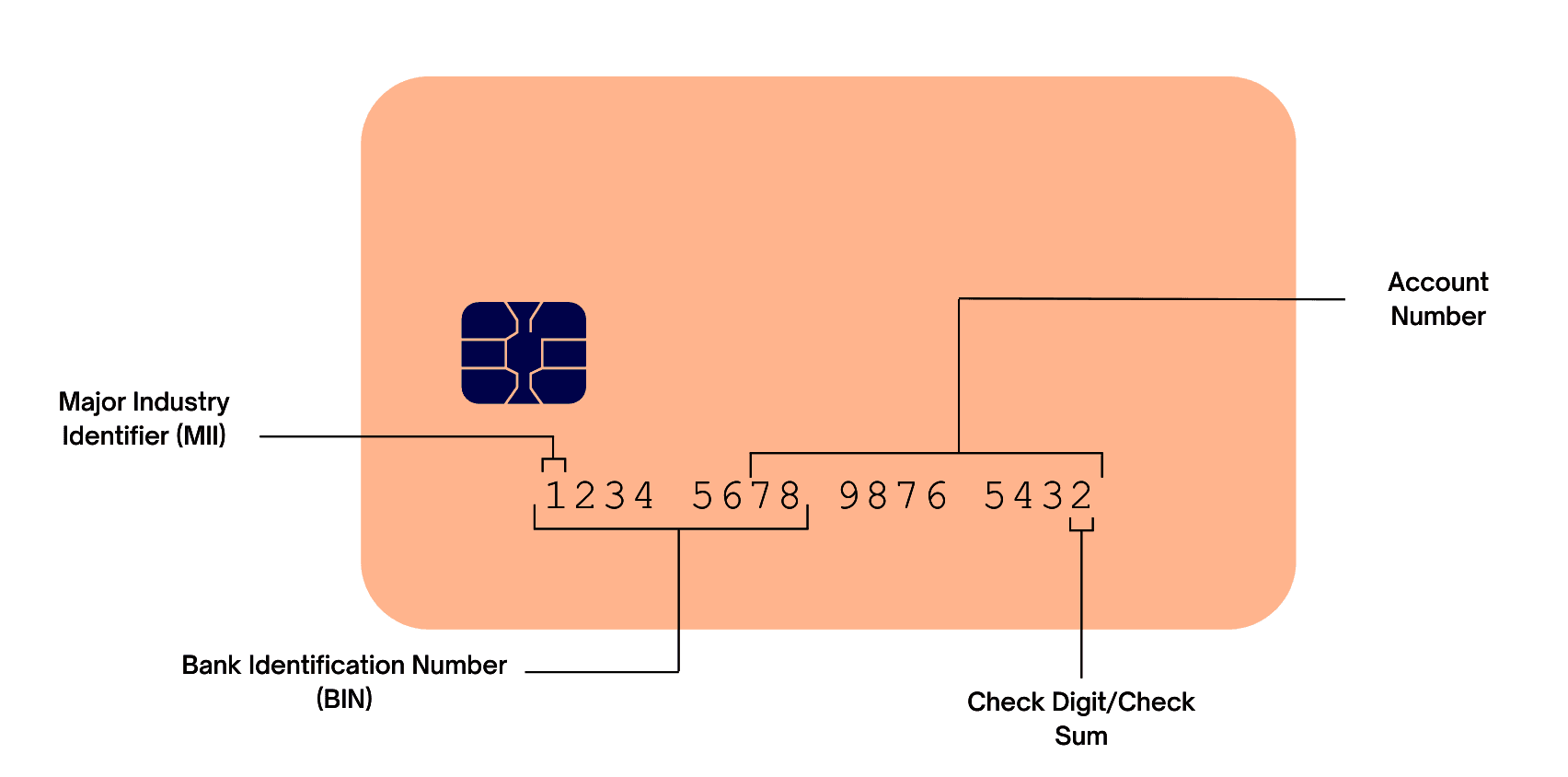
[MII] [BIN/IIN] [Account ID] [Check Digit]
| Component | Structure | Primary Role |
|---|---|---|
| MII | 1st Digit | Identifies the industry/network category (The Rails). |
| BIN / IIN | Digits 1–8 | Identifies the specific issuing institution (The Fingerprint). |
| Account ID | Middle Digits | Links the card to the customer's account (The Identity). |
| Check Digit | Final Digit | Uses Modulus 10 to catch typing/entry errors (The Safety Net). |
Security vs. Convenience: Masking and Truncation
Because the PAN is sensitive, the industry uses specific PCI DSS (Payment Card Industry Data Security Standard) protocols to protect it. It is critical to understand the distinction between two common terms:
- * Masking: This refers to how digits are displayed on a screen (e.g., **** **** **** 1234). It ensures that someone looking over your shoulder cannot see the full number.
- * Truncation: This refers to how digits are stored in a database. To minimize risk, a merchant might truncate the number, deleting all but the first 8 and last 4 digits so that the full PAN does not exist in their system to be stolen.
By understanding these components, you understand the fundamental architecture of the global payments system.
Related reading